
Invisible Fringe
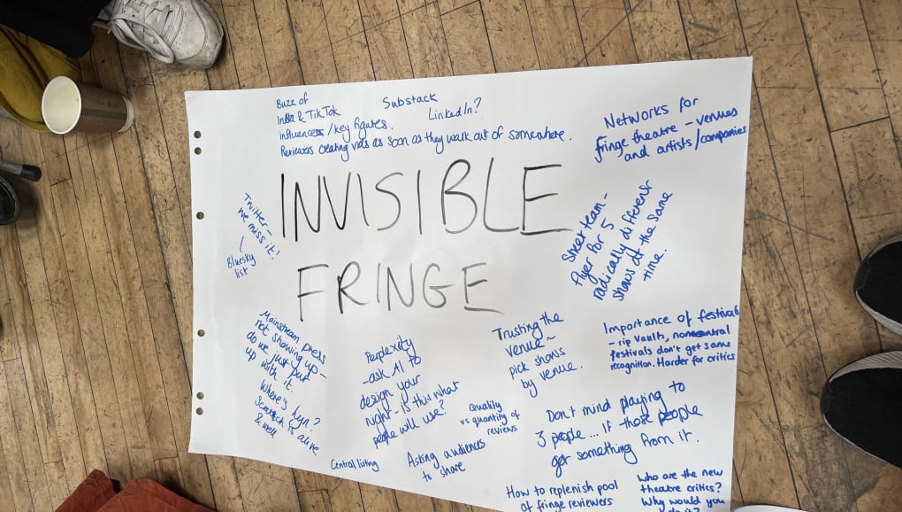
How can we get the attention from press and audiences that fringe theatre deserves? A call to arms from The Cockpit.
Amy Clare Tasker called this session behalf of The Cockpit.
Attending: Sue Knox, Soyeon Kim, Ellie Park, Niamh Hanns, Jasmine Cole , Flossie Waite, Paul Levy, Saskia Baylis, Austin Yang, Amy from Zoo Co, Sue Emmas
There used to be comprehensive fringe theatre listings in TimeOut, and a fringe section in The Stage... now, we rely on "narrowcasting" social media to get the word out about our shows. Now, The Stage proclaims "it's time for a fringe revival" while ignoring the people, companies, and venues who have been working on the fringe for years. The fringe does not need to be revived - it needs to be acknowledged and celebrated.
PRESS
Can AI solve the listings problem? Paul asked an AI to suggest 5 fringe theatre shows to see this week, and it pulled up shows that have had recent good reviews, 2 of which he hadn't heard of before.
Different scales of "fringe" - festivals, pub theatres, subsidised off west end producing venues.
What’s the draw? Venue reputation vs artist reputation vs show topic?
EdFringe has a press release database that all accredited media can access.
Hundreds of publications at EdFringe. Who do we want to be visible to? Quality vs quantity of reviews.
Who are the new theatre critics?
Why are these volunteer roles?
Flossie used to review kids theatre because no one else was doing it. Not sustainable.
Exeunt is back - on Substack.
LinkedIn could also be a useful tool for press & industry visibility?
AUDIENCES
What will fill the void left by Twitter? Social media fatigue has prevented some people (Amy) from signing up for BlueSky. Other social media platforms don't have the same functionality to allow for discoverability the way that Twitter did.
Sue (thisstage) to create a BlueSky list for fringe theatre
Do audiences have a lower appetite for risk these days?
Quality uncertainty
Trusting venues & festivals
Fringe vs curation
Getting the word out
Influencers
Mobilising audiences to spread the word
Vox pops
Festivals
Ecosystem
Partnerships between venues - what are the networks of fringe theatres, ie STAMP?
example of flyering partnerships at EdFringe, with a street team carrying 5 different flyers and handing them out based on conversations with audiences.
Here is a call to arms written by Dave Wybrow, director of The Cockpit.
The movement from print to digital media, the disappearance of comprehensive listings, the simultaneous growth and fragmentation of the live events industry and the decline in press attendance at and coverage of shows has worked to relegate The Fringe. This has happened to the extent that The Stage, for example, has removed the Fringe category from its masthead (and its awards) entirely. Without any category to denote exploratory grass roots work, the paper has reverted to referencing live performance under vintage headings: ballet, dance, musical theatre, west end, youth, community....etc etc. The loss is obvious and needs calling out.
In the case of The Stage there may have been an editorial decision to remove distinctions between different spheres of activity and 'inclusively' treat all theatre as theatre. This comes with problems: firstly it would be more credible if anything but a majority of well established shows and venues were being splashed across its pages; secondly though, it would be a damaging mistake: Hard to define it may be but 'The Fringe' is still a working concept in everyday use by the industry, referencing differing realms of unionisation, production structures, fiscal imperatives, aesthetic priorities, artistic relationships, working methods - and motivation.
Pretending it doesn't exist disqualifies The Stage as a serious commentator as much as it undermines everyone working outside the mainstream.
Worse, a degree of vilification seems to be taking place with fringe theatre attacked by time served Stage commentators (Richard Jordan, Lyn Gardner) for its supposed lack of quality, inability to innovate, reluctance to support industry newcomers - or else reported only in terms of a perpetual crises of funding.
The Stage may be the most visible detractor but of course its not alone
'Legacy' press has by and large stopped covering anything outside of a few mainstream shows.
This is happening at a time when London has overtaken New York as the theatre capital of the world and cultural production features as one of only a handful of growth industries in the UK (FT 5/01/25). It is happening at a time when there is more Fringe theatre production in London, at more fringe venues, with greater diversity of people, ideas and media and with larger audiences than any of us can remember
The Fringe is a crucial part of our successful theatrical ecology. Its where the West-End learns how to do it. But the loss of recognition is not just damaging to the obvious synergies between west-end and off-west. Nor is it just damaging for venues, shows, audiences and careers; it also dumbs down the national conversation around theatre and society.
Theatre in general, and fringe theatre in particular, is politically active cultural production.
Fringe theatre is light on its feet, responsive to real-world events and able to give voice to anyone, about anything. Fringe theatre in the UK, since the abolition of censorship in the 60's, has been part of how our democracy has been mobilised. From radical stand-up to satire to radical cabaret to plays dealing with issues of class, gender and national and international politics.
To stop covering Fringe Theatre is to stop listening: to social critique, to writers prepared to tackle complexity, to people with something to say and an interesting way to say it.
The Fringe still innovates. It still contests. It's still angry. It's still visionary and its still increasing it audience. Can that be said for The Stage? If not, it's time for a new mode of Fringe reportage and discussion. Without it society in general as well as the arts and entertainment mainstream is being denied a key source of renewal and regeneration just as much as the Fringe is being denied its voice.
The Fringe - and the London Fringe in particular - needs to notice it's becoming invisible. Then it needs a symposium. Then it needs a 2025 manifesto. Then it needs, somehow, to get that under the noses of the media: or create its own.
Any ideas?
Let's connect: amy@thecockpit.org.uk & dave@thecockpit.org.uk