
Theatre and Ritual: An Exploration
Personal Context and Artistic Background
I posed the question “What are the connections between theatre and ritual?” at a recent gathering because it has been central to my work for over forty years. My journey in theatre has consistently drawn me towards this intersection, shaped by a wide range of practices, traditions, and inquiries. Throughout my career, I have directed independent companies, taught in drama schools, and engaged in deep research through international workshops and training.
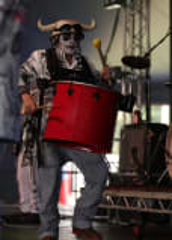
Group Discussion: Theatre and Ritual
During the session on Theatre and Ritual, a group of participants and I discussed many themes that echoed these personal investigations. We spoke about folklore and the tradition of sharing stories in circles, and how this practice fosters community and collective memory. The discussion turned to elders, ancestors, and how a single story can become a vessel for connecting to the past while offering insight and guidance for the future.
A recurring theme was the notion of true experience. In a time when we are saturated with curated personas and false narratives—especially through social media—we questioned what it means for theatre to present real, lived truths. Ritual, we agreed, can be a space for healing. It provides a structure through which personal and collective wounds can be acknowledged, shared, and perhaps transformed.
One young participant remarked that ritual is, at its core, the repetition of meaningful actions—waking, cooking, walking—simple acts imbued with focus and intention. This led us into a discussion on personal versus shared rituals, and how the intentionality behind ritual actions sets them apart from daily habit.
I introduced the sweat lodge as an example—an intense, communal ritual where breath, silence, story, and song are used to create a space of transformation. We explored how this and other ancient practices continue to resonate and hold relevance in contemporary performance contexts.
The Clay Man: Ritual as Theatre
In 1991, I directed a large-scale piece titled The Clay Man, drawing on much of what I had learned from my mentors, particularly during my time with Welfare State International. Inspired by training in Japanese Butoh, my observations of Indonesian funeral rituals, and deeply influenced by Ray Brookes, a sculptor and therapist who worked with clay, The Clay Man sought to embody the ritual impulse through theatrical form.
Ray’s work with clay—and his understanding of the human psyche—deeply informed both my direction and the writing of Kevin Fegan, who collaborated on the piece. Together we explored clay as a metaphor for humanity: malleable, fragile, resilient. The clay figure mirrored archetypes such as the Golem, Frankenstein, and other beings shaped by external hands, brought to life through breath or spark, and often cast aside for their difference.
Though created before the digital age, The Clay Man continues to live on through
photographic archives and written reflections.
And can be found on line under . The Clayman . Padlet .Rikki Tarascas
Ritual to Revolution: A Site-Specific Experiment
Another expression of this enquiry came through a project titled Ritual to Revolution, a site-specific performance set within a church. I worked with a group of skilled and experienced performers to explore the architectural and spiritual qualities of the space.
One theme that emerged in this project was the notion of stained glass windows as early cinema—a powerful visual medium used to dazzle and inform congregations who could not read. The show played with this idea, asking how film and light can now be integrated into modern ritual performance, not to control, but to liberate the imagination.
More about Ritual to Revolution can be found in the
written review from Brighton Source and a short film documentation on YouTube.
The Web of Stories
In our group discussion, we also spoke about the interconnectedness of storytelling. A single image, word, or story can resonate across individuals, triggering memories and associations. This story web was something I first encountered in my work with the late Ray Brookes, and it remains a guiding metaphor in my practice.
Such story webs offer us a way to rediscover commonality in difference, to acknowledge fragmentation, and to move toward reconnection. They are the foundation of ritualised performance: participatory, poetic, and deeply human.