
Directing Is Inaccessible - how can directing and neurodivergence coexist and not collide
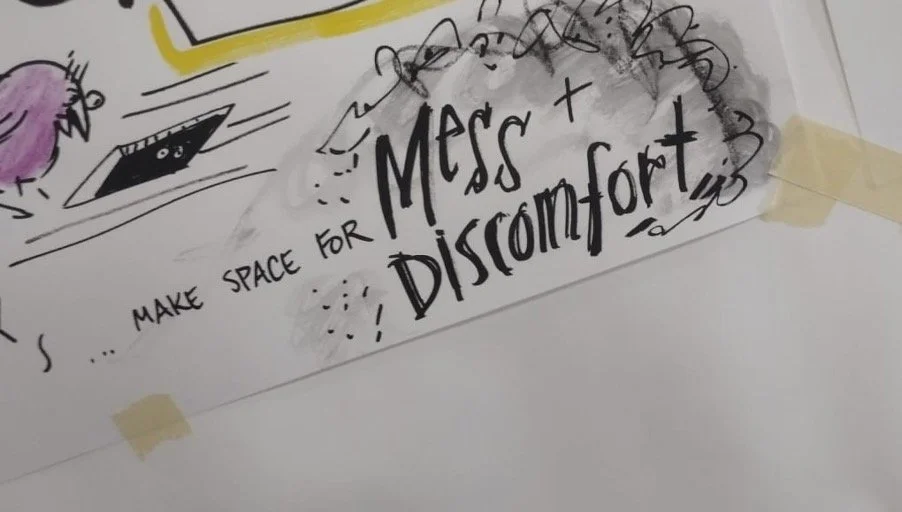
a conversation about the struggle of Holding Space for a room of people when your capacity is at its limit - is that a thing everyone feels? (probably yes) Or is that part of [my] neurodivergence? (also probably yes) Is the crash and the burnout after a project a part of the/my process? Is it inevitable? Or are there things I can change or adapt within my/the process to offer more support and accommodations to myself/the room?
a lot of questions. this session came about as a result of some disgruntlement that other conversations in the main room were missing the mark and not really engaging with things i wanted to interrogate. as a director in the space, still in the early-ish part of my career, and as a neurodivergent person, i am interested in how those two things intersect and what it means to be both of those things at the same time.
myself and beth took ourselves to one of the breakout rooms - very apt - and from our frustration arose a familiar topic of conversation: is it my neurodivergence or is directing just hard? is directing hard and my neurodivergence makes it harder?? HOW CAN WE MAKE IT LESS HARD FOR OURSELVES ???
we spoke about the difficulty we feel in being The Director in a room and everything that role entails and contains. So often being the director requires you to do a lot of emotional labour, working to allow vulnerability to be present in the space but not letting that scale tip too far into oversharing or personal triggers or traumas coming up in a way that is unheld or, for want of a better phrase, unproductive (both in a For The Work way but also in a For The Individual way). How can you allow people to Ask Things Of You - whether that be support or advice or a Space To Process or Feel, whilst still holding firm and supportive boundaries for yourself and your energy? The words that tumbled out of me onto our mindmap were "im not your therapist, im your director."
the conversation turned to how it seems that Director is becoming a dirty word - more and more artists are defining themselves as Theatre-Makers or just Creatives... why is saying "I'm a Director" such an uncomfortable thing? Institutions like the Young Vic renaming their Directors Network to "Creators Programme". How are we supposed to feel empowered as emerging directors in finding our voices and discovering and defining our practice when our literal job role is being invisibilised? From title down to appreciation it feels sometimes. Don't get me wrong, I am a director because I am happy to fade into the background and let the art take precedent and the actors to shine once my work is done.... but it would be nice to be recognised for the sheer amount of work we do, the emotional work it takes, the energetic work it takes, the behind the scenes work it takes, the tangible in-the-space-doing-the-thing work it takes, and the frankly obscene hours of overtime spent on project to project.
There's always more to say... perhaps the question of what the hell the job of a director actually is is a session for another time, because the gods only know it isn't just Staging The Text.
Anyway, we spoke about how Director means Person In Power, which unfortunately also has become synonymous with authoritarianism and self-servingness, and how power itself has become something scary and dirty too. We spoke about the idea of Generous Authority - the analogy being you're hosting a dinner party, you've invited people to your space and in order to make your guests feel the most at ease and comfortable and free in that space, you lay out rules and expectations and give them the information they need to be autonomous there, ie. "please take your shoes off, put them here, the toilets are here if you need them, this is the kitchen, i will provide food, help yourself to a drink" etc etc
obviously there is more work to be done there to enable people to engage with the freedoms and offers you have given them and permission them to actually do those things - but is that not the job of a director? to guide, hold, shape, to Direct when it is called for and Make Final Decisions when it is needed? And it is needed. That's why we're there.
In my practice, I believe in a collaborative approach, in sharing the work of creating with the room you are in and the people who are a part of that process - yet within this there is that fine balance of allowing all the voices to be heard and considered, yet also having a clear goal and steps to get there - and that is also what the director's job is, to have a vision and Get The Thing Done.
This is what a lot of our chats flowed around - how to permission directors to be directors, to permission ourselves to hold that authority while still being generous with it, and how can the whole process be nourishing to the director too.
A quote from beth that stuck with me: "my craft is to hold you, but in that I am also important"
so much of the director's job ends up being holding others' insecurities, egos, fluctuating energies throughout the process, conflicts and disagreements that arise, how to accommodate each individual through their personal and artistic journey and struggles in a process, whilst still Making The Show and facilitating a process that is hopefully enjoyable and stimulating and supportive.... it's exhausting, yet we do it. We find a way.
And cry a lot and require a 2-4 week recovery period afterwards.
I brought up Slow Practice, an ideal of embedding care and support systems and awareness throughout a process, where we have the time and the space to create sustainably for our energy and creativity and make time to look intentionally at the unavoidable tanglings of personal and professional - and how that intention always rubs up against the pressure and demand of immediacy culture, programming, deadlines, budgets etc etc
it feels very Open Space to me, as an approach, how similar the accommodations and ways of running my rooms i've found that allow my neurodivergent brain to process how i need to process, create how i need to create, and allow the people i work with to show up the same way.
it all seems to come back to a self-awareness, a self-empowerment, a process of self-exploration and learning and knowing and discovering that i think has to happen in order to be transmuted onto a theatre practice.
as a trans neurodivergent creative - the more i have learned, discovered, and accepted about myself and how i exist in the world has fundamentally made me a better director. i think at least. the ways i exist challenge the systems in place, systems not built for me and which i do not fit into, so i may as well make my own. i am learning what helps me, and maybe that can help somebody else too.
our session dissolved into chatting and theorising and dreaming and wondering - we took ourselves back into the main room to see if anyone else would float by, and ended up having some more gorgeous and interesting conversations about all of the above and Creating in general with another artist who dropped by
She spoke about her experiences creating solo work, and i ended up speaking more on what i understand Care Practice to be, and though i didn't Call the session, in the next timeslot i lay on the floor with my big A2 sheet and ended up holding that conversation too... a report on that is also on its way if you're interested.
final thoughts and reflections on this though, i can't help but notice that it's 3 people socialised as women who are reflecting on these questions, on this practice, on what it means to direct, to make, and the insecurities that come with it, and maybe even the sub/unconscious expectations placed on us that come with being a Director and also perceived as Woman.... I'll let you do some more of the thinking on that.
my AuDHD brain does that overthinking overanalysing overexplaining literally all of the time
what do you think this is
And a question, if you're a cis man....have you ever thought about this too? Do you have these questions? Genuinely. I'm really interested.
[title image credit: Beatrice CohenBaum ]