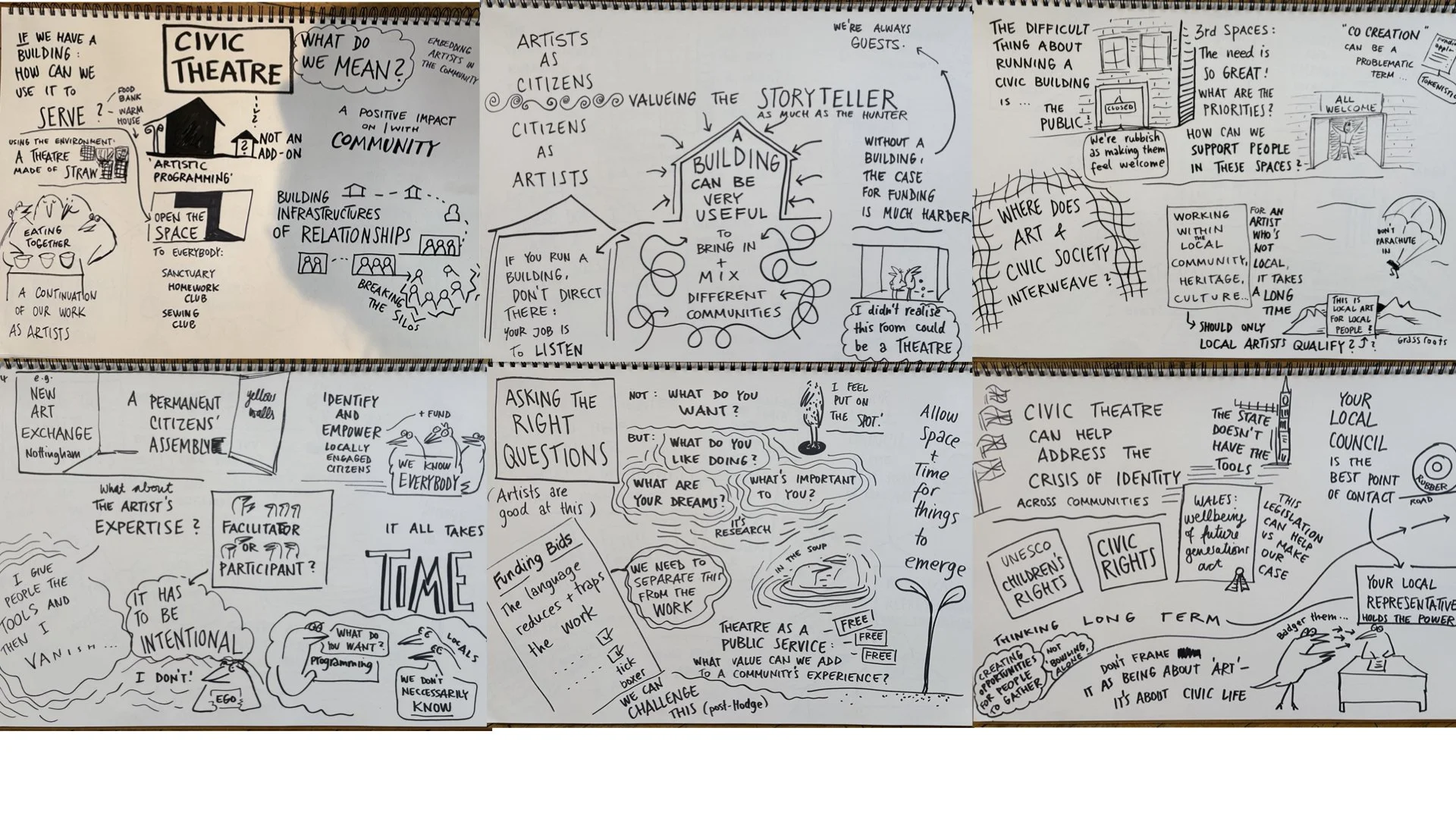
Civic Theatre - What do we mean? What could it be?
I called this session because 'civic theatre' is a term I see being used more frequently in the sector. Often, without proper thought.
Theatre has always been, 'civic' for me; deeply connected to community, serving of citizens needs, a responsibility in bringing people together in order to tell a story that helps us better understand ourselves and the world.
We talked about how 'community outreach' and 'main stage programming' are often cut off from one another and that feels like such a waste.
There is a bias towards 'artistic programming' that sometimes isolates those audiences we are trying hard to reach. Is it a lack of relevance and participation?
We talked about the power of being in a 2-way conversation with community and taking responsibility for the power of our tool - theatre. Is it an act of service? Our job to give back?
A big question was 'what does the community want? And how can we discover that?' Also, 'what does civic theatre feel like?' Can we describe that feeling of profound togetherness and connection that can be achieved through theatre?
Someone described the work of PeerGrouP, a location-based theatre company in Northern Netherlands. They described a performance exploring the sugar industry (a key industry in the region. They built the auditorium out of materials used in the livelihoods of the people an environment. It was both everyday and extraordinary.
This took us on to the pros and cons of buildings and the freedom to be more adaptive without one. If there is one, how can theatre buildings be more available for civic use? Warm hubs, Foodbanks (SlungLow), craft circles, theatres of sanctuary. How do you expand the asset of a building? Who gets to decide how these spaces are used? People need to define it for themselves. Surely participatory democracy is key to holding this work? Resident power. But to be a civic theatre you have to be open to disruption! If you truly share the power, you can't control it. We discussed the work at New Art Exchange (Nottingham) and their permanent citizens assembly.
We talked about Matt Fenton's civic work when leading Lancaster Arts, giving local residents a direct role in programming venue performances. There is often an argument that community-engaged work doesn't sell as well as something that might come from a singular AD's taste. The publicly programmed seasons at Lancaster were their most financially successful at the time.
We also discussed whether you need to come from a community or already live within it, to do this work. No parachuting in please and careful when using the word 'co-creation'. It feels important to be from a community but not necessary, if there is deep listening and understanding of cultural nuances and someone takes the time to do that work. It takes time. And it should. 'Artists in Service' - What would that look like? Money for artists to embed themselves in communities rather than product-pressure. We talked about the value of creativity and artistic interpretation too. What is that balance with public service? Surely artistic interpretation is a public service? The magic of showing people what they didn't know they wanted and needed and wouldn't have been able to tell you at a town hall meeting! On that, let's think about the questions we're asking. Do people know know what they want? Will they find it by you asking them that question? What if we brought our artistry and creativity to shaping the questions better in order to go deeper?
And let's think about ego. Maybe find a way to feed it elsewhere? We often risk overthinking our own roles when we're not the most important people involved.
And what of our third spaces? They are slowly closing down. How can we equip artists and communities to re-activate those spaces?
We talked about the gorgeousness of rural touring and how it often doesn't matter what the show is. If we show up, they show up!
We discussed the power and influence of local cultural leaders, often not officially titled one, but earned through years of community service and listening. How do we care for these people? Not see them as 'cultural gatekeepers' but really value their integrity. Build trust with these people over time. They won't share their thoughts and connections if they don't trust you.
Do we value the community storyteller in society enough? They've been around since civilisation began. They were just as valued as the hunters. What's stopping us from truly valuing this role in the UK?
We celebrated Alex Oates, AD of The Tute in Northumberland and his work informing civic programming.
What does relationship as infrastructure look like over buildings as infrastructure?
One participant shared that local authorities are at a loss on community cohesion and civic identity. Arts can fill this space and help solve some of the issues. We can change the criteria and legislation. People are powerful. Let's look at the relationships between local authorities, mp's, community and the arts. How can funding language evolve to meet our work rather than the other way around?
The Hodge Report talks about giving artists and orgs more freedom to describe their work in their terms. How do we step up to that challenge? How can we carve out space to think with freedom?
We finished by talking about Robert Putnam's 'Bowling Alone' and the recent documentary 'Join or Die'. He asked, 'What are the conditions for an engaged society?'. Turns out civic gathering is everything. Check out Bob's work, if you haven't already.