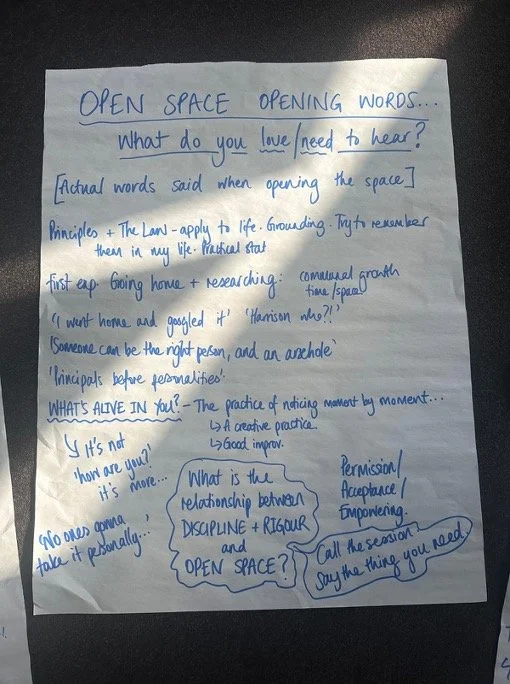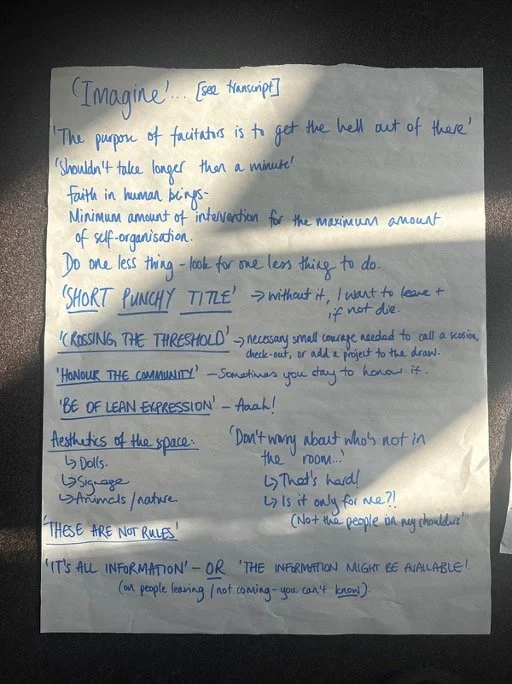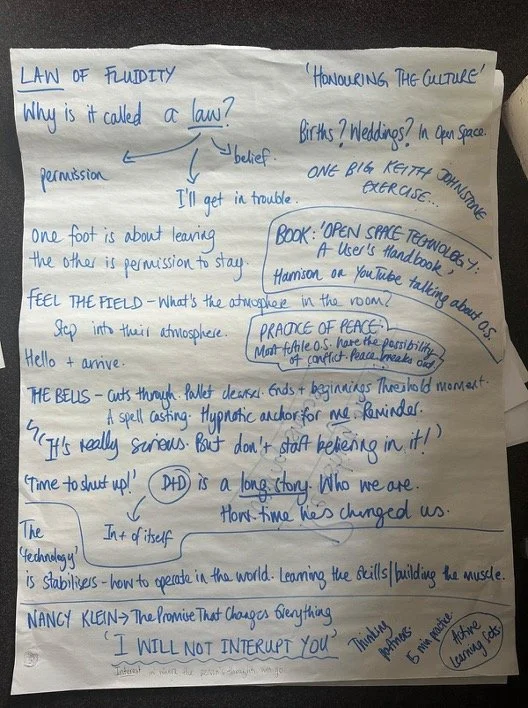
What parts of the Open Space opening do you love/ need to hear at the beginning? Can I gather them?
Flo O’Mahony from Zoo Co.
This discussion was attended by lots of people who felt passionately about Open Space. We deliciously agreed and disagreed about what mattered, or lands with us, or doesn’t matter.
How long it should take, or not, to open the space. How the space can feel more open or more closed, whether Open Space is being named, or not!
Here’s some notes from our notes.
WHAT’S ALIVE IN YOU? - This question feels deeply important for checking in, developing the muscle and skill that is active noticing, active listening, to yourself and others, so the Law of Two Feet can be used!
It’s not ‘how are you?’ - it’s more.
The practice of noticing is critical for creativity. We must garner it!
LAW OF TWO FEET, or THE LAW OF FLUIDITY -
The Law of Two Feet can be interpreted (or misinterpreted) as solely an invitation to leave. But it’s more than that. The two feet might be the one that takes you away, and the one that makes you stay, or commit to being here, and changing what needs to be changed so that you can stay and do your work.
There was a provocation shared that opening the space should take only one minute. Harrison suggested that the work of the facilitator is to find one less thing to do!
‘Minimum amount of intervention, for the maximum amount of maximum amount of self-organisation’
---
SHORT PUNCHY TITLE - ‘I went to an event once where this vital piece of guidance was missed, and I wanted to leave if not die!’. Calling the session and starting the session must be two different things!
‘CROSSING THE THRESHOLD’ - When sessions are called, or evening news is shared, the feeling that a small act of bravery or courage might be needed creates a lens that means we share what is needed, or urgent, not just talk because we think we must have something to say.
HONOUR THE COMMUNITY - I might have misinterpreted this, but I think the person raising this was suggesting that if you facilitate Open Space, you must stay present in the room in order to honour the community that is gathering (without getting in the way!)
BE OF LEAN EXPRESSION - Can feel like a hate crime for me (a yapper) but feels like an important provocation for keeping the community alive
AESTHETICS - make the space you are in mirror the practice - the dolls (dreaming), the signage (DIY) the animals (reminders of nature)
‘DON’T WORRY ABOUT WHO’S NOT IN THE ROOM’ - Can feel confronting if a/ your community isn’t present - do you carry them? Put them down for the day? Invite them next year? Call them up to weigh in on a session?
Why is it called A LAW? (Surely it isn’t?)
Because it counterbalances the assumption that the Law of Two Feet will get you in trouble, that it is implicitly rude to follow your feet. Calling it The Law tackles that assumption.
FEEL THE FIELD - How do you know how to start opening the space? Do you plan the first line?
You feel the field, notice the weather/ atmosphere in the room, and you step into it.
THE BELLS - why?
A chance to notice an ending/ beginning. A nice noise. An invitation to dreaming/ difference/ change. A way of getting people’s attention that doesn’t involve yelling ‘GUYS! SsSSSHHhh!’. A reminder for the facilitator to drop in and begin.
The technology of Open Space is stabilisers for a skillset we can develop for working in every aspect of our lives, OS or not. Using it is like working a muscle, a reminder of the fire of what’s alive in you, of your agency, power and what being in community feels like.
---
The conversation veered towards other practices that remind us of Open Space. We spoke about Nancy Klein’s book - The Promise That Changes Everything. The promise is ‘I will not interrupt you’. At this point, I felt this statement firing in me in a visceral way. What might life be like if I made that promise? I’m going to spend some time with that.
As I was having an existential conversation within myself, others went on to talk about Active Listening Sets, Long Table formats, sessions you can have with Thinking Partners (Nancy Lein) - 15 minutes that go like this:
5 minutes speaking about anything you want to. No interruptions. If you run out of steam, your partner might ask - what else do you think/ feel?
5 minutes with the other person doing the same.
2 minutes each to offer appreciation to the other person for what they shared (not solutions).
Done? I think? I don’t know, I was having an existential meltdown xxx
Here is a note-taker summary of the conversation, from the transcript I recorded - I haven’t checked it for accuracy, but I think it hits many of the conversation points!
https://docs.google.com/document/d/1n8vy2hakLCFdg5NejE0zIc9aK8QvDkzFg1kHGNokt0A/edit?usp=sharing
Here are pictures of the notes taken -