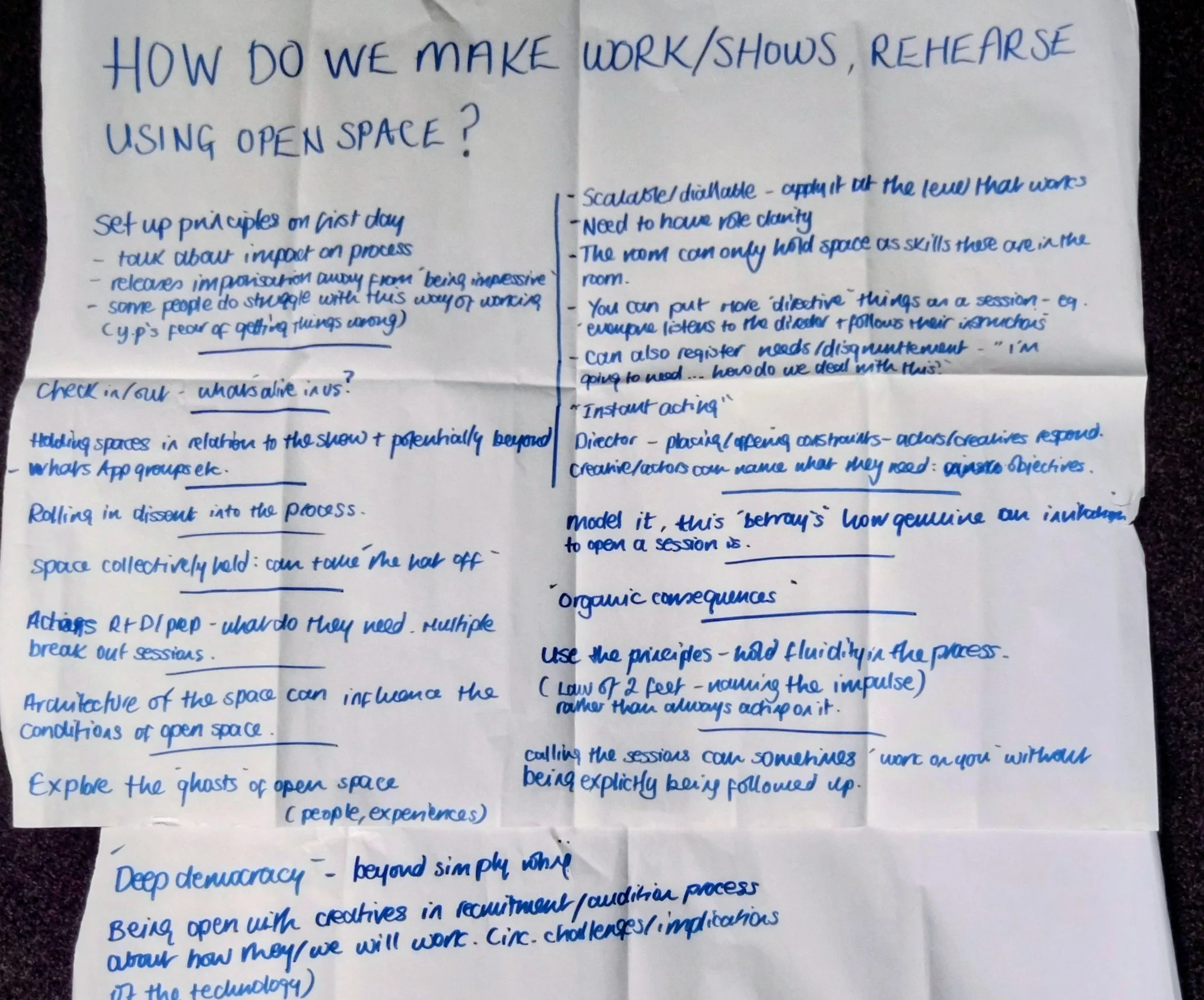
How do we make work/ shows/ rehearse using Open Space Technology?
Written by Emma Adams and Deborah Pakkar-Hull (together we are Old Bird)
Emma's reflections: The photo captures the main takeaways of this conversation (amazing capturing, Deborah THANK YOU).
I want to say a massive thank you to the 15-20 or so people who came to be part of the conversation. It was generous, fascinating and inspiring. And I felt the spirit of this conversation (about open space) kind of embodied the principles. Which was beautiful.
There are so many things that were said which I am going to be chewing over as we think about how to take open space into the ways we work in our company (we being Deborah Pakkar-Hull and I. Together we are Old Bird). But I think the 4 big points to add to the diagram of the conversation (for me) are:
1) Taking on Open Space into making and rehearsal is a movement away from brittleness towards flow. A movement towards naming the things that are in the room (which will be there whether named or not) and a movement towards allowing people to bring their talents in whole ways. It has the potential to hold and enfold. To take the weight of a process off of the shoulders of 'the writer and director'.
2) That all said, it doesn't erase difficulty or discomfort from a process. It asks us to sit with that difficulty and find solutions together.
3) It can be as simple as putting the laws/principles up on the wall and moving with care from there. But a thing that came up quite a few times is that it is ok to evolve your own way of doing open space.
4) The limitations of a process are fine, but it's important to name them. So if a day has to involve a tech rehearsal then it's fine for a director to call a session which is about doing the technical rehearsal. Similarly, it's fine to acknowledge that sessions can only be useful in a rehearsal process if the people in the room have the skills and knowledge to hold / investigate / action those issues. Processes can become difficult/don't work when the limitations of process aren't named. But folding in difficulty/naming & welcoming what is happening in the process (not allowing what one feels should* have happened to derail)/and being honest is the key.
*Sometimes, a thing that has to happen - like performing the show that you have sold tickets for - does have to happen. That's ok. See the bit about naming the restrictions/boundaries that exist.
Deborah's Reflections:
The only other things I would want to pick out are the concepts of 'organic consequences' and the idea of sessions working on those in the room, whether or not there is dedicated time in the process given over to them. Both of these speak to the notion of trusting the process, and allowing things to happen in an almost alchemic way, rather than always needing conscious human effort and action. I find this fascinating.