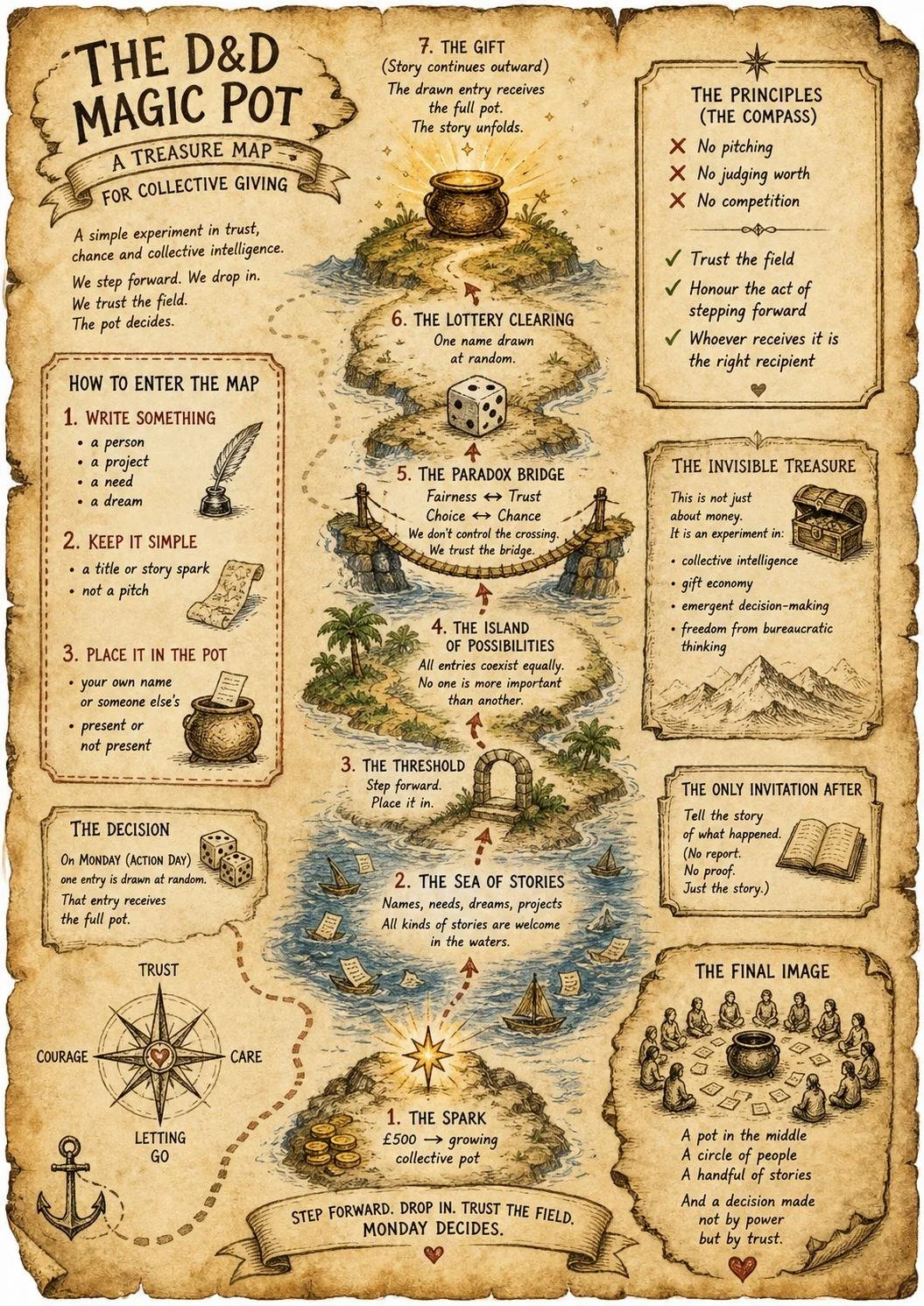
DISTRIBUTING FUNDS IN OPEN SPACE A POT OF GOLD FROM D&D TO GIVE TO WHOEVER/WHATEVER WE WANT.
Summary — D&D Open Space Session: The Magic Pot
Core question
The session explored whether a group gathered in Open Space could responsibly, freely, and collectively decide what to do with a pot of money — starting with £500 from Improbable, which grew during the session to around £765 through donations.
The deeper question was not simply:
Who should get the money?
but:
Can Open Space create a better, freer, less bureaucratic way of distributing money than conventional funding systems?
⸻
Origin story
Phelim began with the story of a long-standing idea: asking Arts Council England to put £100,000 in the middle of an Open Space and let the theatre community decide what to do with it.
That idea partly inspired Seth Honnor’s show The Money, where audience participants decide collectively how to distribute a real pot of money. But Phelim was interested in something less theatricalised and more truly Open Space: not a staged contest, not a pitch, not a performance of worthiness.
The question became:
Could D&D itself test this idea with a small amount of money?
⸻
Examples and references shared
People brought several models into the room:
1. The Money
A live event where people sit around a table and must reach agreement about how to spend a pot. If they fail, the money rolls over.
2. Blue Stocking Society
A group where members pay a small regular amount, creating a pot that is given annually to someone’s proposed project.
3. Small grant-giving charities
One participant described a small theatre company that became a tiny grant-giving body and sometimes acted as a match funder.
4. £1-a-week mutual aid model
A system where 500 people give £1 a week, and each week someone receives £500, often through informal knowledge of need.
5. Nudge Fund
A £300 fund that gave people a small, validating push to do something they might otherwise leave undone.
6. Lottery-based funding
Phelim mentioned research discussed by Malcolm Gladwell suggesting that lotteries can sometimes reduce bias more effectively than judged selection processes.
⸻
Major themes
1. Gift, not grant
A strong principle emerged: this should feel like a gift, not a mini-Arts Council process.
Phelim referenced Lewis Hyde’s The Gift: a true gift is given without expectation of return.
The group resisted:
* formal pitches
* proof of worthiness
* impact assessments
* reporting as homework
* judging who is most deserving
Instead, the spirit was:
Receive this. Do something with it. Tell the story.
⸻
2. Story, not pitch
There was a strong aversion to the word pitch.
The group wanted some kind of storytelling or naming, but not persuasion. The emerging form was closer to the Open Space session-calling ritual:
Say what you are putting into the middle.
Give it a short title.
Let it exist.
Then release it.
The story or title gives the pot meaning, but does not become a competitive speech.
⸻
3. Randomness as liberation
The group became interested in combining:
* a threshold of commitment
* with a random final selection
The threshold: someone must care enough to put an idea, person, project, or need into the middle.
The freedom: once something is in the middle, it is not judged. The final choice is made by lottery.
This avoids recreating a funding panel.
⸻
4. Whoever comes are the right people
The group kept returning to Open Space principles.
The session asked:
* Should the money only go to someone present?
* Can someone nominate someone who is not there?
* Does being present matter?
* What about people excluded from D&D by money, time, access, or confidence?
A rough consensus emerged that people present at D&D could put something into the pot, either:
* for themselves
* for another person
* for a project
* for someone not present
This preserves the principle that the people in the room are the ones who can act, while also allowing the money to travel beyond the room.
⸻
5. The money may matter less than the blessing
Several people noted that £500 is not a huge amount, but it can have symbolic and energetic force.
It can:
* validate a dream
* create momentum
* help someone pay themselves for thinking time
* unlock match funding
* give credibility
* nudge something stuck into movement
* carry the blessing of D&D/Improbable attention
The gift may be material, but also mythic.
⸻
Key tension
The room wrestled with a central paradox:
How do we care about need, fairness, access and impact
without recreating the very systems of judgement we are trying to escape?
This was never fully “solved”, but the proposed mechanism tried to hold it:
* anyone can put something in
* no one has to prove worth
* the room hears the stories/titles
* the final choice is random
* the recipient is trusted
⸻
Proposed process / rough consensus
By the end of the session, the group seemed to reach a rough consensus around the following process:
The D&D Magic Pot
1. There is a physical pot/bucket/hat in the middle.
2. People may put forward one proposal, name, need, person, project, or idea.
3. It can be for themselves or for someone else.
4. It should have a short title or story-spark, not a persuasive pitch.
5. These can be put in during circle times across the weekend.
6. More money can be donated into the pot.
7. On Monday, Action Day, one entry will be randomly drawn.
8. Whoever/whatever is drawn receives the pot.
9. There is no formal report required.
10. The recipient is invited to tell the story of what happened.
⸻
Possible wording of the spirit
This is not a pitch.
This is not a competition.
This is not a test of worthiness.
If there is a person, project, need, dream or action you want to place in the middle, write it down.
Give it a short title.
Put it in the pot.
The final choice will be random.
The trust is deliberate.
The gift is real.
Whoever receives the money is the right person.
Whatever happens is the only thing that could have.
⸻
Things not to forget
* The pot began as £500 and grew during the conversation.
* The group was not only distributing money; it was prototyping an alternative funding culture.
* The process should rhyme with Open Space, not with grant bureaucracy.
* “Pitch” felt like the wrong word.
* “Gift” felt like the right word.
* The group wanted story, but not judgement.
* Randomness was not seen as careless; it was seen as a possible antidote to bias.
* There should be a threshold of care: you have to step into the middle.
* The result should make people feel more free, not newly burdened.
* The next iteration could become a larger experiment for future D&Ds.