
How Do We Support Each Other to Take Risks?
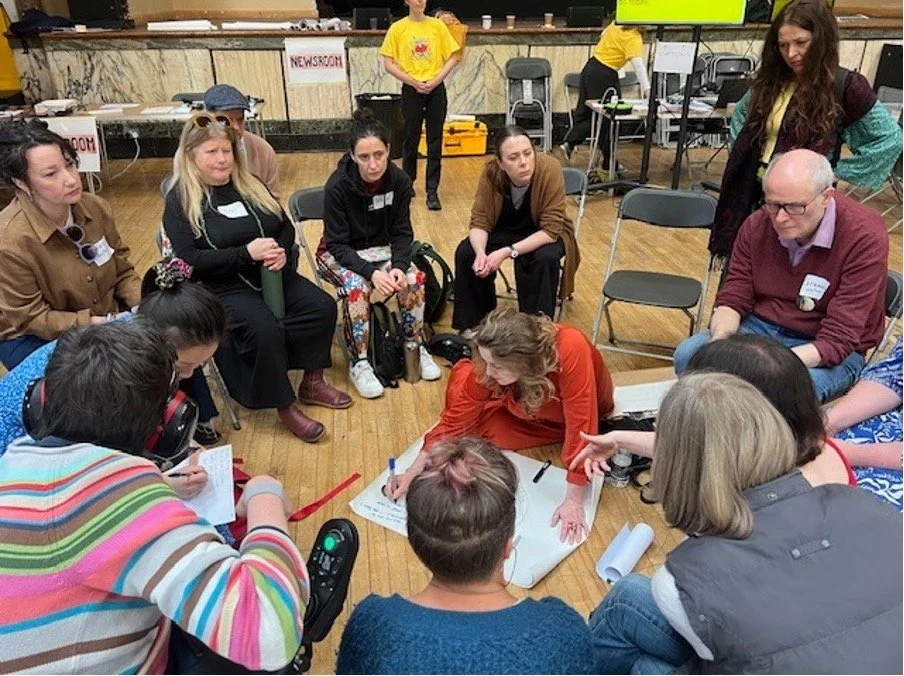
In an increasingly risk averse environment more and more work we would define as 'risky' is being stifled or not made at all. Venues are avoiding as much financial risk as possible and Artists and companies are being refused slots if the funding for the project is not already in place. How do we support and encourage risk, at exactly the moment we need risk taking work more than ever?
It was a big conversation with a lot of people in and out of it, but the original core group of contributors were: Stella Farina, Jodi-Alissa Bickerton, Rachel Valentine Smith, Natalie Chan, Jesse Parrott, Anna Carr, Katherine Woodward, Flo O'Mahony, Gemma Goggin, Stephen Bush, Kimberley Sykes, Marissa Beatty and Cheryl Prince.
We began by talking about access needs and heard from a performer living with Dementia who talked about the risks a company had to take, and mitigate for, when working with them. We noted that the need for venues to know exactly the content of a work to mitigate risk is totally incompatible with improvised work or a show that has improvised elements within it. It was noted that a recent controversy where a show's entire run was cancelled due to the theatre deeming content was too risky, was in fact nothing to do with the script but with design elements!
So how do we enable unpredictability whilst still respecting the audience's right not to be unexpectedly triggered?
We felt a strong solution to much of the issue would be for consortiums of venues to be created that could support 'risky' work from inception to tour; a coalition and collaboration - not a 'take over' or censorship relationship, but one where venues could understand the work and its inherent risks from the start and mitigate for those.
These consortia would also enable the financial risk of the work to be shared more evenly - for example marketing and audience development could be created for the show by all the venues together.
We are stuck in a vicious cycle where there is a perception that audiences don't want to see 'risky' work, so the venues don't book it, but if the venues don't book it then those audiences cannot be developed - if 'Adolescence' has been Netflix's biggest show to date it clearly isn't the case that audiences don't want to be challenged by risky work!
It was observed that at the moment all new work is considered 'risky' by venues regardless of the subject matter.
HR is a massive missing piece in venues and companies and does create risk for all involved - better HR tailored to the needs of the industry would help.
However, it was noted that there are legal implications for venues alongside safety. I referenced the experience my company had where we became the registered office for Basingstoke Pride as none of the committee wanted a personal address for their own (understandable) safety concerns. We then were notified that an individual had written to one of our funders, having pulled our information from the Charity Commission, and was attempting to claim we were committing fraud. This was dealt with quickly and effectively by our funder, but the fact that the tactics used by these people has changed is alarming - it isn't just social media trolling or protests outside a venue anymore!
We noted ruefully that even if you have a successful 'risky' show it doesn't mean you'll get to do that again.
There is a concern that Drama Schools and other forms of training are not encouraging risk taking in their students - both in terms of subject matter and form.
There is sometimes a lack of communication between marketing departments and programmers - the work has been programmed for a reason but sometimes the marketing team don't understand that rationale, and therefore don't know where to target their efforts.
Venues that are creative hubs, that are involved in supporting Artists and companies (this doesn't always mean financially) to create work are generally more likely to take risks on the work. Incubator spaces and similar opportunities have been disappearing. We need strategic collaborations to help increase the resilience for venues and Artists.
However, Artists do need to get better at describing their work - there is a disconnect between the Artists' description and the finished work which hinders the programming process and marketing to audiences.
Financial risk is huge - subsidy for venues was created originally to help keep ticket sales affordable - this is no longer the case.
There was an idea regarding the huge numbers of small studio/rehearsal spaces inside larger buildings that are no longer programming or producing; consortiums of companies and Artists could be using and even operating those spaces. Why couldn't they be trained by the venues as Duty Managers to ensure legal safety compliance when working in the spaces?
Artists need to sit on the boards of buildings to ensure change happens - but it was noted that for many being able to volunteer time as a Trustee was not accessible to them. So could there be funded places for freelance Artists on boards?
Artists and Venues need to be more transparent with each other - venues should enable Artists to access all areas of an operation to understand how it works - boards, administration, finance, marketing etc - but again, how are these individuals financially supported to do this? Even understanding the full range of Theatre Tax Relief is not offered.
Devolution also is an oncoming consideration - the Mayoral system looks as if culture will be within the portfolio of the Combined Mayoral Authorities and not the smaller Unitary Councils - which will mean there could be a political disconnect between Government (ergo DCMS and ACE funding and policy) and the Mayors - there will be Reform candidates standing who will define 'risk' in terms of content very differently - what happens then to the theatre buildings these authorities own and fund? There is also an opportunity here though as well - ensuring an area is telling and showing the stories that are pertinent for their demographics, means much work defined as 'risky' content may well find its home with Mayors who govern over areas with those communities. But, only if we can make contact and communicate effectively with these Mayors!
There is a removal of the Artistic Director post in receiving houses - and with less Artists running buildings the risk taking has been significantly reduced. There are very few paid Associate Director roles in venues - the route I took - one that enables me to be an AD & CEO because of the experiences with all aspects of operating a venue as well as Producing. The separation of the roles mean that we have a huge amount of venues with Executive Directors in the senior leadership position who then demand that programming has to be financially 'safe'.
We talked about the new £1 levy on Stadium tickets for Music events - the bands Pulp and Elbow have already signed up to this - and the proceeds will form a fund that Grassroots venues can apply to for support. Could something similar be introduced into West End venues?
We also talked about a higher rate of Theatre Tax Relief being applied to touring work to recognise the sheer disparity of costs producing touring compared to the fees and guarantees being paid - which incidentally have not increased in 15 years, maybe more!
Could there be more support for theatre from streaming companies like Netflix that are benefiting from writers in particular creating content from them that have come from a theatre background?
There are interesting commercial examples - you can't co-invest on a show made with public subsidy - but some shows that are made within the subsidised sector are then re-made for touring with commercial investment.
Esmee Fairborn apparently will fund underwriting a tour of an existing show - but there are strings attached!
It was a lively and far reaching discussion with a wonderful group of people - we had some ideas for solutions, but it struck me that communication between venues and
Artists is the key to all of this, and a greater transparency from all of us.